
Resources
Black-tailed Godwit Movement Explorer
Godwit Movement Explorer is a shiny app that allows anyone to navigate and explore black-tailed godwit Limosa limosa tracking data swiftly and conveniently. It was designed and created by Taylor Craft, and, among other tasks, one can quickly identify individuals tracked in a given area of interest, and immediately extract how many locations exist for those individuals in that area.
Black-tailed Godwit site connectivity
The Shiny app below, “Connectivity Perspectives”, allows you to explore how the migrations of Black-tailed Godwits connect sites throughout the East Atlantic Flyway. This app was developed for the paper Beal et al. (2025), as a support tool to facilitate discovering the complex movement networks that Godwits create.
Best practices for archiving and publishing shorebird movement data
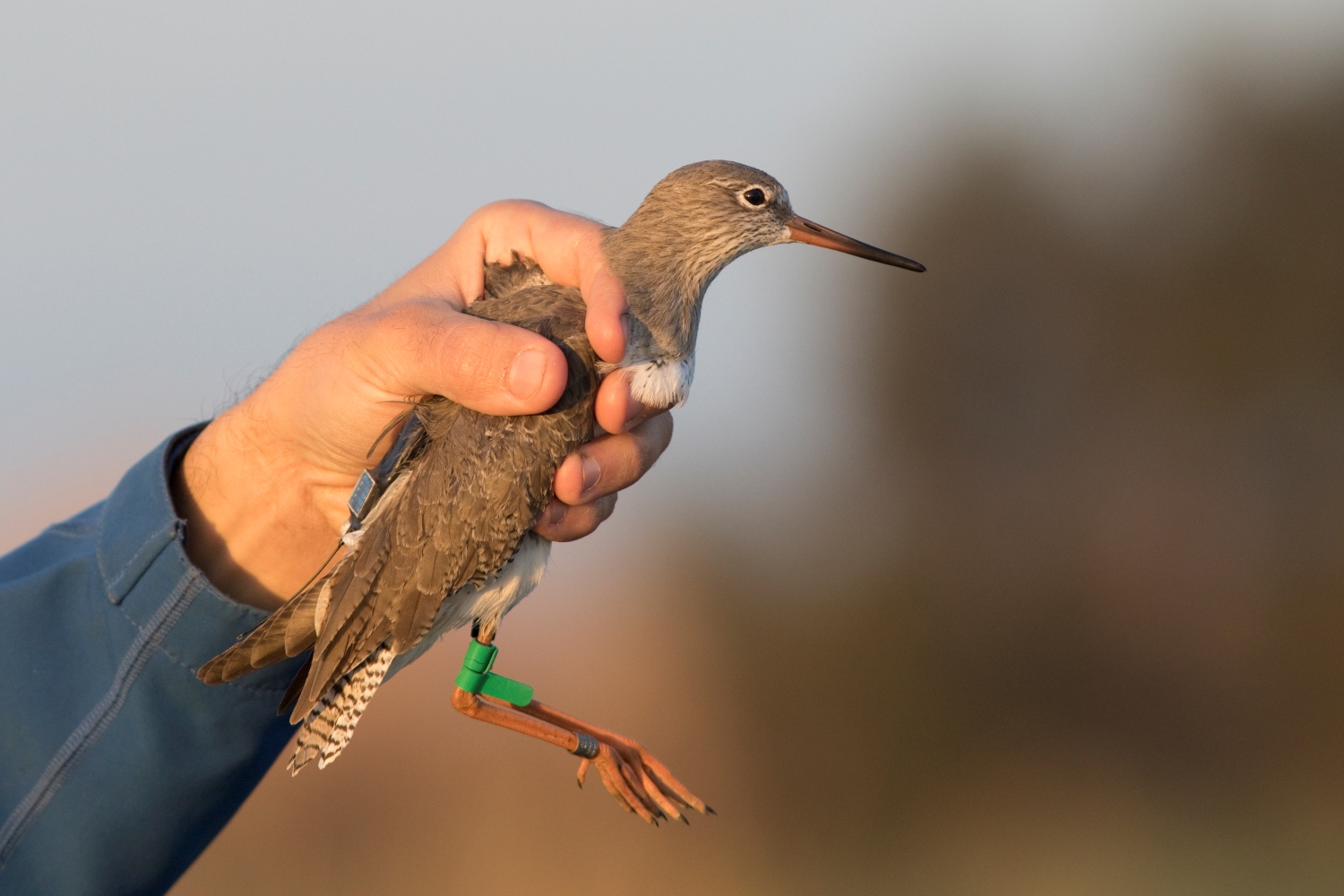
- Archiving increases the probability that datasets can be reused for future research, conservation and management. This is particularly important from an ethical perspective, as tagged animals that have carried devices may have endured some level of disturbance or discomfort. Maximizing scientific value from these data helps justify that investment and any potential detrimental consequences that such individuals may have experienced while carrying any device.
- Whenever possible, make datasets publicly available (even if only after an appropriate embargo period). Public archiving greatly increases the long-term accessibility, impact, and reusability of the data.
- Whilst the data cannot be made public, ensure that the repository contains up-to-date contact details for the data owner, together with at least one alternative contact person, in order to reduce the risk of datasets becoming inaccessible.
- Accompany datasets with clear and comprehensive metadata. Other potential data users should be able to understand exactly how the data were collected, processed and formatted without the need of contacting the original data owners.
- Whenever possible, use community repositories designed specifically for animal movement data. Although movement data can be archived in several repositories, we recommend Movebank because it provides standardized data structures, long-term management and broad community support.
Movebank-specific best practices for shorebird data
Movebank provides two complementary services:
1. Movebank is the working platform where researchers upload, manage and share movement datasets (“studies”) throughout a project's lifetime.
2. Movebank Data Repository is the formal archiving service where completed studies can be published with a DOI, a permanent citation and an explicit data license.
Metadata
- Include all available information about tagged individuals, such as age (or age class) at deployment, sex and any morphometric measurements. These variables are often essential for movement analyses.
- Record deployment information carefully. At a minimum, specify the deployment date and time for every tag.
- If the tag detached, failed, was recovered, the bird died, or some other event by which no subsequent data attained by the transmitter no longer represent the originally tracked individual, record the deployment end date and the reason whenever possible. This prevents incorrect analyses, including the accidental inclusion of data collected after tag loss or redeployment of a recovered/refurbished device.
- Verify that all imported variables are correctly mapped to Movebank attributes. This is particularly important for automatic uploads from live data feeds.
- Include information on the tracking device itself whenever available, such as manufacturer, model and tag mass.
- Provide as much accompanying information as possible. Field observations, capture details, habitat information, colour-ring combinations, breeding attempts and other ancillary data may prove invaluable for future analyses, even if they appear unimportant today.
Data quality
- Perform basic quality checks before data publication, including verifying timestamps, coordinates, duplicated records, impossible movements and missing metadata.
- Include measures of location uncertainty. Whenever available, archive quality metrics associated with each location fix (e.g. HDOP, VDOP, number of satellites, or other device-specific accuracy measures).
- Clearly document any filtering or processing that has been applied to the data before uploading it so that other users understand whether locations represent raw or processed observations.
Geolocator data
- Follow the established recommendations for archiving geolocator data, including both raw light-level data and inferred positions whenever available. Proper archiving of raw data allows future improvements in calibration and analytical methods to be applied.
Accessibility
- Consider applying an embargo period when necessary to allow sufficient time for the originally planned analyses (often the reason underlying device acquisition and deployment). Movebank supports embargoes of up to 10 years.
- Make the study title and summary publicly visible whenever possible. This increases the discoverability of the dataset while allowing the underlying data to remain under embargo if required.
- Choose an appropriate open data license and include a suggested citation for the dataset upon publication.
List of tracking devices
Below you can find an online sheet with a (non-exhaustive) compilation of tracking devices available in the market by October 2023. Contact us (globalwader@waderstudygroup.org) to suggest changes or updates.
Publications
Here you can find all publications arising from the Global Wader project, as well as those that stem from collaborations facilitated by Global Wader.
- Carneiro C., Gunnarsson, T. G., (...), Alves J. A. (2026) A global perspective on the annual cycles of whimbrels. Ibis https://doi.org/10.1111/ibi.70111
- Michel G., Nightingale J., Beal M., Bernard A., Dias M. P., Alves J. A. (2026) Global review of shorebird tracking data to identify research gaps and conservation priorities. Conservation Biology: e70211 https://doi.org/10.1111/cobi.70211
Contact us at globalwader@waderstudygroup.org
Thanks to Eunbi Kwon for the device list. Header and tagged common redshank photos by Triin Kasiku